
The Art of Enoughness
The Art of Enoughness written with a picture of two koalas hugging.
This fall I checked a big item off my bucket list. I ran my first ultramarathon. Not only that, I ran 31 miles on Saturday and then on Sunday I ran 13 miles to earn a Wild Woman award and a hatchet. This is something I have wanted to do for years. I worked hard, set expectations, and then did the thing.
Even though fewer than 0.01% of the global population has completed an ultramarathon, when I am out there running and someone passes me or flies downhill faster or finds energy at the exact moment I hit the wall, a creepy little voice pops into my brain. It whispers, You are not doing enough. You are not trying hard enough. You are not gritty enough.
In my earlier years of running, that voice would take me down. One whisper and the spiral began. I would feel bad about myself. I would slow down. I would walk. I would lose momentum and confidence.
But this year something shifted.
I have done a lot of work around self talk and comparison. My mantra when running has become, “Run your own race. Run your own race.” And yes, I am the annoying lady cheering for strangers as they pass me. You are doing amazing.
The “enoughness” monsters cling less tightly when I meet them with joy, perspective, and compassion.
Running is one thing though.
Work is another.
If I can get swept into an “enoughness” spiral while doing something as objectively absurd as running 44 miles in a weekend, imagine how distorted the landscape becomes in social impact work. We are asked to solve problems that have not been solved. To innovate without a roadmap. To meet needs that grow faster than our teams ever could.
The potential is endless and the opportunities are countless.
Which means the finish line is always moving.
No wonder “enough” feels impossible.
No wonder we often feel behind.
No wonder the Never Enough soundtrack plays on repeat.
This is why we need a different way to think about the work.
We need a mindset shift.
We need a practice.
We need The Art of Enoughness.
Why “Enoughness” Feels Like Lowering the Bar
Let’s speak plainly. For a lot of us, naming something as simply “enough” feels wrong. To me the word, “enough” sits in that old C-range of the grading scale. You met the expectations, but you did not exceed them. You showed up, but you did not dazzle. No gold star. No extra credit. It feels like giving up too soon. It feels like letting someone down. It feels like stepping away from a fire that clearly needs more from us.
What I’m learning to realize is that we did not invent these beliefs.
We absorbed them.
And we live in a system that continually makes us feel out of control.
But we have the power to take action in the overwhelm.
Many of us became the reliable ones, the helpers, the fixers, the people who quietly carry the invisible load. We learned that going above and beyond was the only acceptable way to show up. We learned that our value was tied to how much we could hold.
So when someone suggests “enoughness,” it can feel like surrender.
But surrender is not what we are talking about.
What we are actually naming is right-sizing.
“Enoughness” is not about shrinking.
It is about placing the bar where it belongs.
To practice it, we have to understand what pushes us away from “enough” and into overextension.
Scarcity Tricks Us Into Overreacting Instead of Right-Sizing
If you work in social impact, scarcity is not an abstract concept. It is your daily backdrop. Limited funding. Limited time. Limited staff. Limited beds. Limited capacity. Limits feel like our native language.
But living in scarcity all the time does not make us better at working within limits.
It makes us worse.
Scarcity pulls us into fear-based thinking.
It tells us that if we do not do more, something will fall apart.
It convinces us that taking on extra work is the safest choice.
It pushes us to overfunction because we do not trust that support will come.
As Vu Le often points out, nonprofits are swimming in scarcity while other sectors operate from a mindset of abundance. Some industries assume resources are plentiful, innovation is endless, and risk-taking is the fun part. Vu tells the story of the wifi-enabled electric juicer that raised a gajillion dollars in investment. A juicer. Connected to wifi. And when compared to simply squeezing the pouch by hand, hand-squeezing was faster and more efficient.
That story captures the gap.
One world is drowning in not enough.
Another world raises millions for kitchen gadgets.
Scarcity becomes our default lens.
We say yes because we fear the consequences of no.
We overextend because it feels like the only responsible choice.
We ignore real limits because acknowledging them feels dangerous.
And that is just the professional side.
Do not even get me started on feeling “enough” as a parent. That is its own Olympic sport in emotional scarcity.
Scarcity does not teach us to adapt.
It teaches us to override.
This is where organizational design comes in.
Organizational Design Reminds Us We Have Tools to Counteract Scarcity
While society and our internal narratives often push us toward “never enough,” we have tools in our work systems that can help us push back.
Intentional organizational design is one of the most powerful.
Organizational design is not just org charts. It is the practice of shaping how people and systems work together. It is how we build clarity, flow, psychological safety, shared expectations, and alignment.
It is one of the few places where we can actively undo the cultural training that tells us we are always behind.
Healthy organizations do not confuse unlimited effort with effectiveness.
They do not reward burnout as commitment.
They do not rely on heroics to make the work happen.
Instead, they build minimum viable structure. The smallest set of practices, agreements, and ways of working that reliably support the work.
Too much structure creates rigidity.
Too little structure creates chaos.
“Enough” structure creates momentum.
We may live in systems that whisper we are never doing “enough,” but inside our organizations we can build cultures that tell a different story. Cultures that support clarity. Cultures that distribute load. Cultures that allow people to do work without sacrificing themselves.
Organizational design is one of the places where the art of enoughness can actually take root.
The Art of Enoughness in Practice
Here is the part that matters. “Enoughness” is not a formula. It will never be perfect. It will never be a checklist.
It is a practice. An art. Something you return to again and again with curiosity, honesty, and humility.
And while you can practice it alone, the real power shows up when you practice it with other humans. Enoughness grows stronger when teams talk about it openly. When we name what is realistic. When we adjust expectations together. When we right-size the work in community instead of pretending we all have superhuman capacity.
Practicing the Art of Enoughness out loud is brave. It is vulnerable. And it is one of the most meaningfully connective things teams can do.
Below are three lenses that help you develop this art. These are not tests. These are invitations. I also invite you to build a practice of reflection with your teams so you start collecting real time data on this. Use this as a guide.
1. Conditions: The Landscape You Are Working Inside
Every artist adjusts to the light in the room, the surface of the canvas, the materials available, and the weather outside. Leaders must do the same.
Conditions are the external realities shaping what is possible.
They include:
the season your organization is in
stacked deadlines or competing priorities
illness, turnover, or capacity disruptions
major funding shifts
unusually high community demand
holiday weeks or school breaks
weather or operational disruptions
Conditions tell you what the landscape actually is. They ground you in the reality you are creating inside.
Reflection questions:
What is happening around me that affects what is possible right now?
What conditions are shaping my week, my team, or this project?
What constraints or disruptions deserve to be acknowledged rather than ignored?
What would change if we expected ourselves to work with these conditions instead of pushing through them?
2. Capacity: The Materials You Actually Have
No one paints a mural with a dry brush. Yet we often pretend we have endless internal supplies when we don’t.
Capacity is the internal reality.
It includes:
time available this week
physical or emotional energy
cognitive bandwidth
number of humans and hours available
skill level or confidence with the task
the invisible load people are carrying
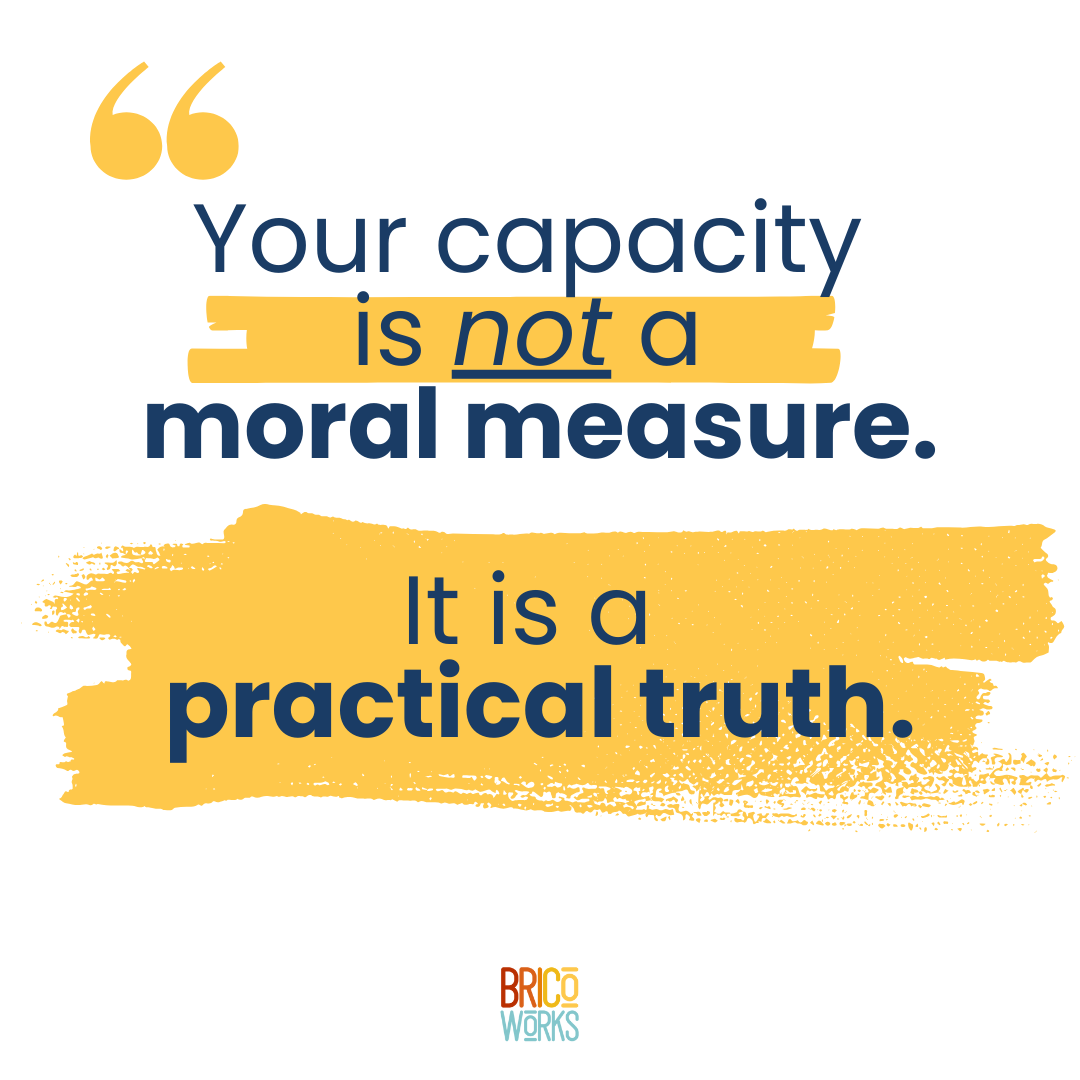
Capacity is not a reflection of your worth.
It is a reflection of your truth.
Naming capacity is not an admission of weakness.
It is an act of responsibility.
Reflection questions:
What do I actually have available to give this right now?
What does my team have available?
What emotional, cognitive, or physical limits are present that I have not fully named?
Where am I pretending I have more capacity than I do? Why?
What would “enough” look like if we honored our real capacity instead of our idealized one?
3. Context: The Purpose Behind the Work
Artists do not use the same brush, stroke, or level of detail for every piece.
Work should function the same way.
Context is what helps you right-size effort.
It clarifies:
the true purpose of the task
who it is for
how it will be used
what the stakes actually are
what outcome is needed right now
the minimum effective dose
Context helps you distinguish a masterpiece moment from a “good enough to move forward” moment.
Reflection questions:
What is the actual purpose of this work?
Who is this for and how will they use it?
What outcomes matter most right now?
What is the simplest version of success here?
What level of quality is truly required and what is optional polish?
If I had half the time, what would I prioritize?
Bringing These Lenses Together
The Art of Enoughness begins when you can look at:
the conditions you are in
the capacity you have
the context of the work
and ask:
What is “enough” for this moment?
Not perfect.
Not maximal.
Simply “enough.”
Some days the strokes will be messy.
Some days the clarity will be sharp.
The point is not perfection.
The point is perspective.
And the real progress happens when we stop practicing this alone and start practicing it out loud — in teams, in partnerships, in collaboration. Naming “enough” together is where courage meets clarity, and where burnout begins to lose its grip.
What “Enough” Looks Like in Real Life
“Enough” might mean sending a version that is 90 percent refined because that is what the moment calls for.
“Enough” might mean ending your day when your brain is done rather than forcing two hours of low-quality work.
“Enough” might mean designing a meeting with one clear purpose instead of five.
“Enough” might be telling your team, This is what we can take on right now.
“Enoughness” does not shrink your ambition.
It strengthens your impact.
“Enoughness” does not erase excellence.
It makes excellence sustainable.
“Enoughness” does not limit your care.
It keeps you able to keep caring.
A Final Truth
Ultramarathons and leadership share a strange kinship. Both force you to confront the gap between what you expect from yourself and what your actual body and brain can sustain. You can fight reality and burn out. Or you can meet reality and find a rhythm you can hold.
The Art of Enoughness keeps pulling me back to what is real and what is possible. It reminds me to run my own race whether I am out on a snowpacked trail or navigating a day shaped by strategy, community work, and humans who need care.
If this practice helps you quiet your Never Enough soundtrack, celebrate the progress you are making, and choose a version of “enoughness” that supports your life and your work, that is the whole point.
We deserve that kind of leadership.
We deserve that kind of life.
Let’s practice it.
