Buoys & Tethers
Buoys, Tethers, and Staying Human in a Dark Season
As we near the end of what has felt like the longest January of my life, and for many people living in Minnesota right now, I’m holding fear, hope, and resilience very close. Often all at once.
This month has not been abstract.
First, Renee Good was killed by a federal agent in Minneapolis. Then, weeks later, Alex Pretti was also shot and killed by federal agents. In the middle of those milestones, countless acts of chaos, cruelty, and inhumanity unfolded. Families torn apart. Children used as bait and then left in detention centers. Fear wielded intentionally. Not as a byproduct, but as a tactic.
All of it landed in real bodies, real homes, real communities.
My own response was immediate and physical when Renee died. I felt myself pulled inward. Retreat. Protect. Stay small. Grieve quietly. When Alex was killed, that instinct intensified. My husband was in Minneapolis that day, standing with others, witnessing, supporting. When I realized how close it was, fear told me to pull back even harder. To keep the people I love close. To reduce risk by shrinking my world.
I also know this. I have the privilege to retreat. Physically, I can create distance from Minneapolis. Culturally, the color of my skin and my identity afford me protections others do not have. That awareness reminds me that retreat feels understandable and is also deeply insufficient in this moment.
What kept me from disappearing entirely were what I now think of as buoy moments.
Buoys as hope that floats
After Renee was killed, hope did not show up as optimism or clarity. It showed up as flotation.
Buoys are not dramatic. A buoy simply exists where it exists, steady in the water, offering something to grab onto so you do not drift too far under or too far alone.
My buoys were small and unremarkable on the surface, but incredibly powerful.
Conversations in parking lots that lasted longer than planned.
Meetings that were intended to meet another purpose, but we made space for connection instead.
Check-ins that slowed the pace just enough to breathe.
Shared grief that did not require fixing or explaining.
Sitting across from someone with nothing urgent to accomplish except being present.
These moments did not remove the fear or the sadness. They did not make the losses easier to carry. What they did was keep me from sinking into isolation. They kept me connected to my own humanity.
At the time, I did not have language for it. I just knew that connection, even in small doses, was what kept the darkness from closing in completely.
When language caught up to lived experience
This week after the killing of Alex Pretti, Brené Brown shared reflections on power that stopped me in my tracks. She named how chaos and cruelty are often used intentionally as tools of “power over.” How fear and overwhelm are meant to untether us from ourselves and from each other. How isolation is not accidental, but strategic.
That framing gave language to something I had already been living.
The buoys that kept me afloat were not just comfort. They were resistance.
And since then, the concept of tethering has stayed with me. The way I’m holding these concepts are:
A buoy is a moment of support. A lifeline.
A tether is a relationship you strengthen over time that can fortify both.
Buoys help you stay above water when the storm hits.
Tethers help you stay oriented when the storm does not pass quickly.
Buoy moments with friends, neighbors, strangers has been profoundly impactful. Tether moments with people I hold and care for deeply have been core to moving me forward.
Hope, fortification, and quiet resistance
At the same time as all of this grief, I have been unexpectedly fortified by hope.
Hope has shown up in the people of this state.
In the quiet courage of parents organizing.
In neighbors checking on each other.
In the outpouring of care from people watching from other places who refuse to look away.
Cruelty tries to isolate. Care keeps finding cracks to grow through.
What I keep witnessing is that the effort to untether us is not working. Not here. Not in the small, human places that do not make headlines.
People are choosing connection anyway.
Both in loud ways and quiet ways.
And that matters.
How to help in a moment like this
If you are wondering what to do right now, I keep coming back to this simple frame:
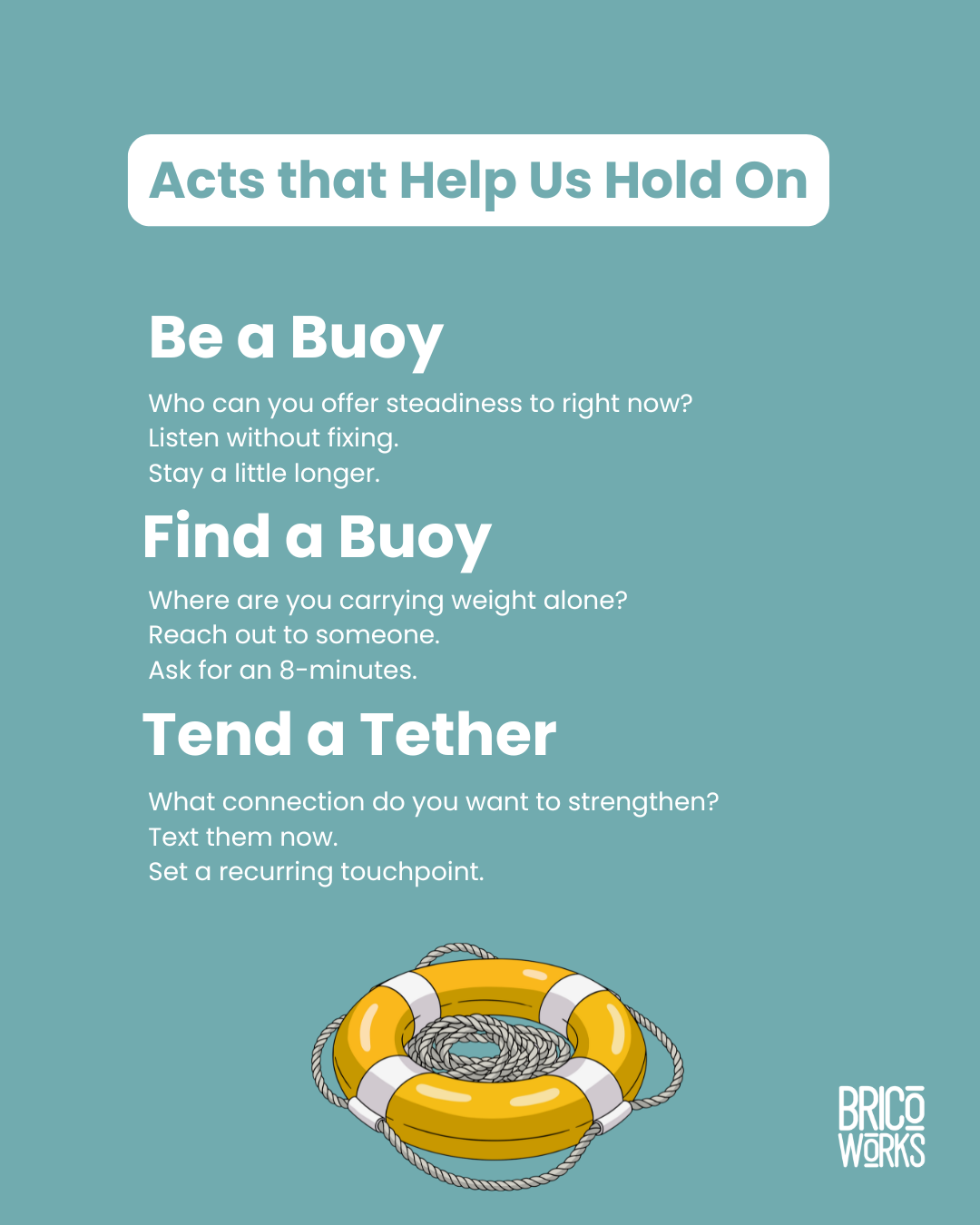
Be a buoy.
Find a buoy.
Fortify a tether.
Being a buoy looks like offering presence without judgment.
Finding a buoy looks like allowing yourself to reach out.
Fortifying a tether looks like saying, “I am here, and I will come back.”
You do not have to do everything.
You do not have to do it publicly.
You do not have to have the right words.
Staying connected, in small and steady ways, is how we stay human in dark seasons.
And right now, that is not soft.
It is structural.
It is resistance.